
Mechanical Engineering
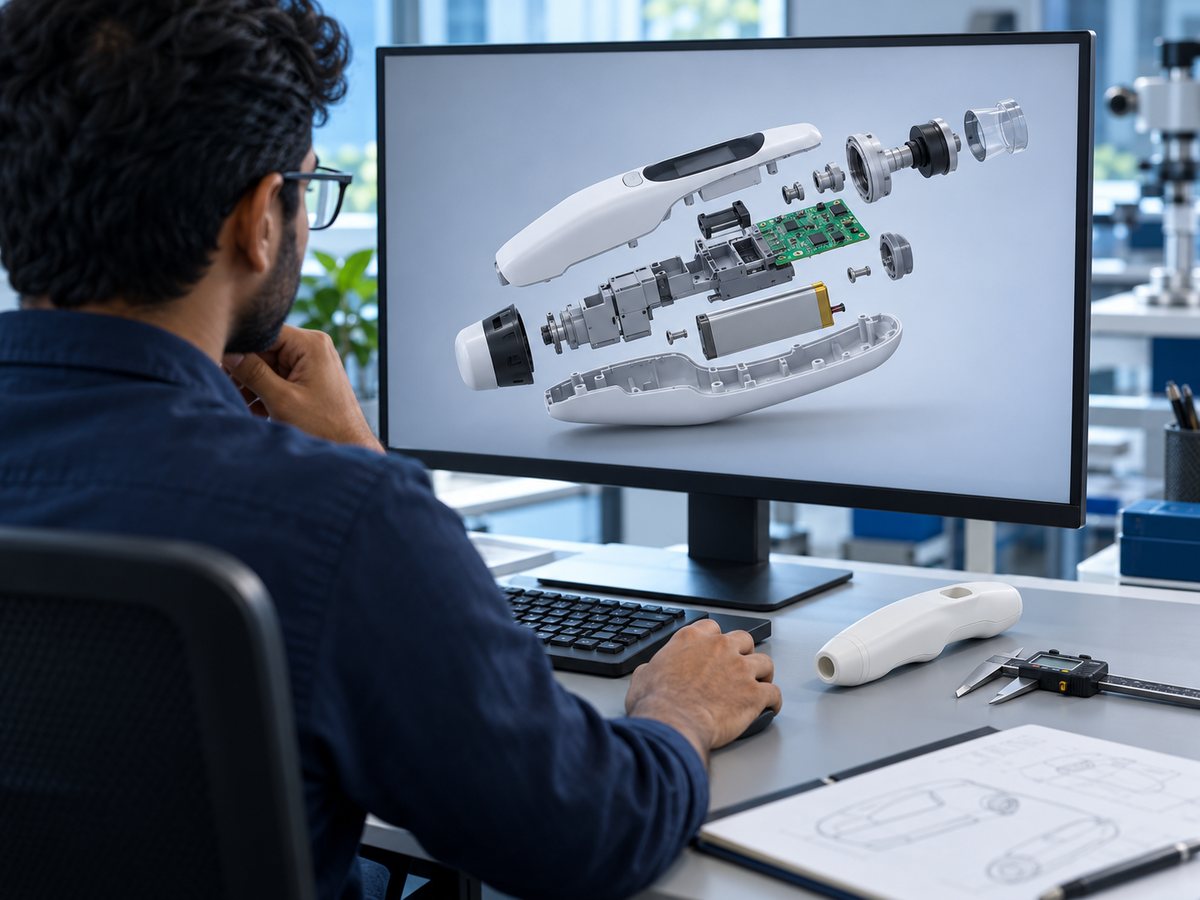
The physical device: the parts, how they fit and how they are made, with biocompatibility under ISO 10993 in view from the first material choice.
When Mechanical Engineering Is the Right Step
Once the concept and the form are chosen. Mechanical engineering turns them into parts that fit, seal, carry load and can be made at the cost you need.

Turn a Concept into Parts
A proven concept or an industrial design that now needs detailed parts, assemblies and drawings.

Make It Manufacturable
A prototype made by printing or machining that must move to moulding or another production process, at a cost that works.
Solve Fluid, Heat or Seal Problems
Fluid paths, thermal limits and sealed or sterile-barrier features, where the physics decides the design.
How Mechanical Engineering Works
What You Bring and What You Get
You Bring
- Requirements, with numbers where you have them
- Industrial design surfaces or a prototype
- Target cost and expected volumes
- Materials and suppliers you already use
- How the device is cleaned or sterilised
You Get Back
- 3D CAD models
- Released 2D drawings, with tolerances
- Tolerance stack-ups
- Design for manufacture review
- Mechanical test reports
- Bill of materials
Questions Clients Ask
Why involve a supplier during design?
A moulder or machinist sees draft angles, wall thicknesses and tolerances that add cost or cause defects. A change in CAD costs less than a change to a tool.
Do we need finite element analysis?
Where a part carries load, gets hot or moves fluid, and its failure could harm someone, analysis helps settle the design before testing. Where a simple test answers the question, a test is often the better choice.
Which parts need a biocompatibility evaluation?
Every part that touches the patient or the user, directly or through a fluid path. ISO 10993-1 sets the evaluation by the type and the duration of contact. Parts with no body contact do not need it.
Have a question about Mechanical engineering?
Opens the contact form with this service named. Nothing is sent until you press send.